

The German Education Experiment: Why I’m Terrified but Trusting the Process
Coming from a culture of early academic rigour, the German emphasis on 'play' feels like a risk. Here is why I am taking it.

👋 Welcome to a ✨free edition✨ of Kulturshift. Every week, I decode the quirks of life in Germany 🇩🇪 to help you move from confusion to connection. If this story resonates with you, consider subscribing to support my work and follow Sourav Dey for more honest expat insights. 🥨
Do you ever feel like you are gambling with your child’s future?
I do. Almost every day.
I have been living in Germany for three years now. To be honest, I still feel like an outsider. My German is broken at best. When I drop my son off at his Kita (Kindergarten), I often struggle to understand what the educators are telling me about his day. I nod, I smile, and I walk away, hoping I haven’t missed something crucial.
In the silence of my own home, the doubts creep in. Am I making a mistake raising him here? Is this relaxed system actually working, or am I just letting him drift?
But then, earlier this week, a single photograph stopped me in my tracks.
The Butter Knife Revelation
I was looking through photos from the week of my son’s fourth birthday. There was a candid shot of a home-baked cake cut by him.
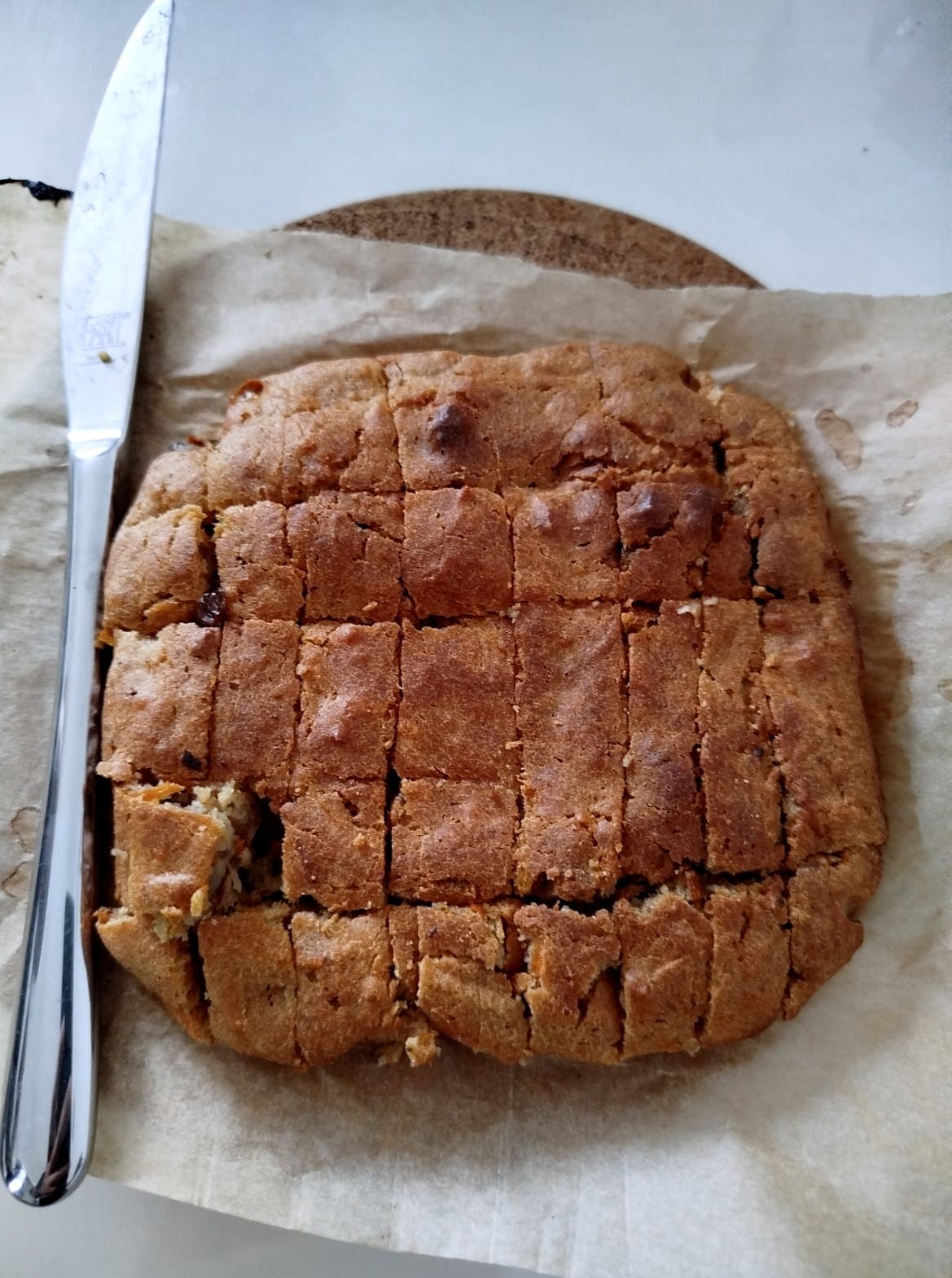
He was using a dull butter knife. But I found myself zooming in on the slices of the cake. The slice was precise. I remember that his grip was firm. There was a quiet efficiency in his movement that startled me.
As an Indian father, I admit: I still struggle to cut a cake that neatly. Yet here was my four-year-old, doing it with a focus I hadn’t taught him. For a brief moment, the knot of anxiety in my stomach loosened.
Wiring vs. Reality: The Internal Conflict
I cannot blame myself for worrying. I am fighting my own programming.
I was raised in India, where the race begins before you can tie your shoelaces. By age 3.5, you enter Lower Kindergarten (LKG). By 5, you are in Upper Kindergarten (UKG), sitting at a desk, writing sentences, and preparing for a life of academic competition. That system is hardwired into my brain as the “correct” way to parent.
Then, I look at my life here in Germany.
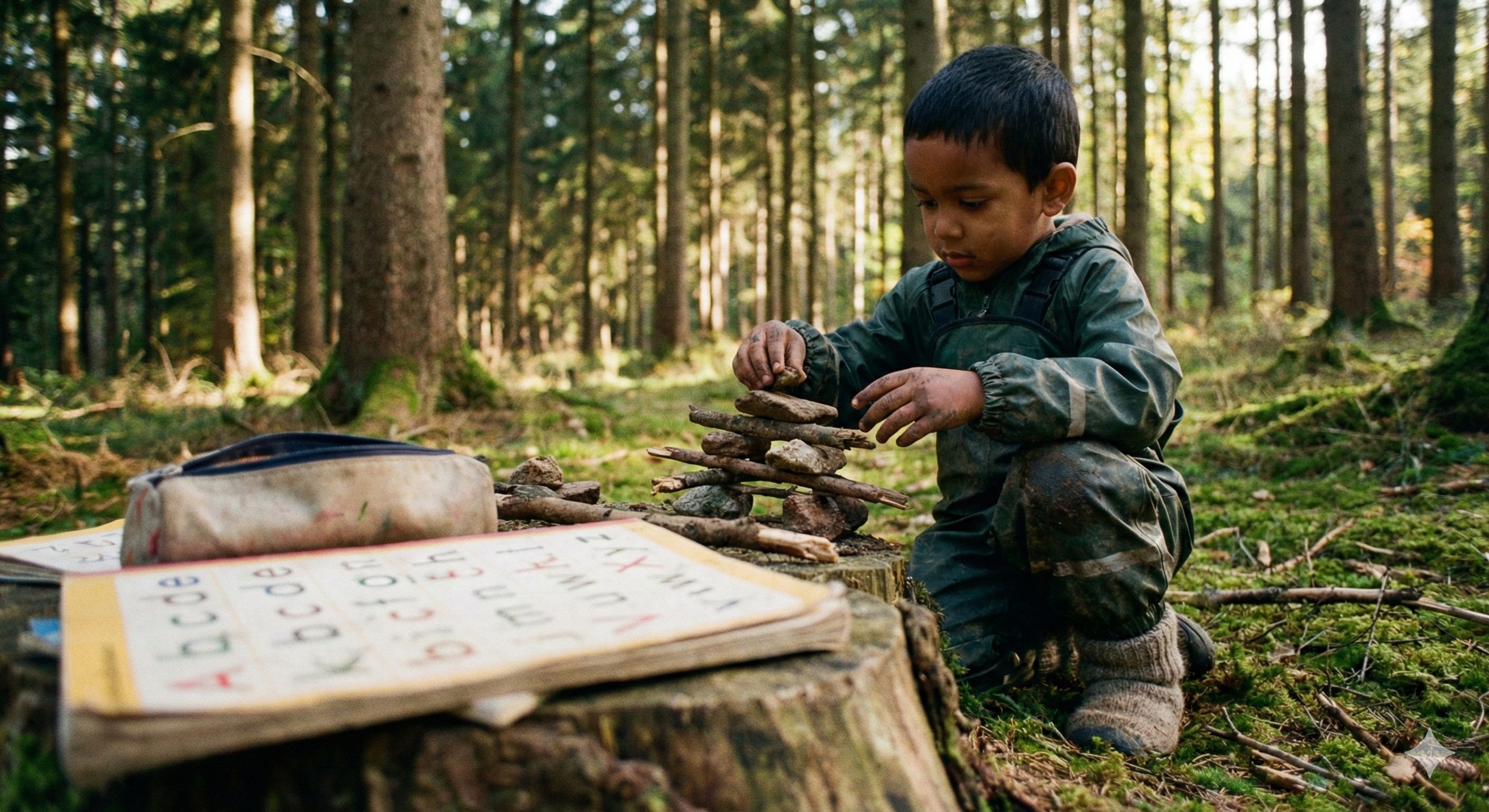
My son attends a mixed-age group. He isn’t taught to write his name. He isn’t drilled on the alphabet. Some days, I pick him up, and he is covered in mud, having spent the entire day playing outside.
When I see him playing while his cousins back home are studying, I feel a pang of guilt. Is he falling behind? Because of my language barrier, I can’t even “homeschool” him in German to catch up. I feel helpless.
🌱 Building Resilience: The Kita isn't the only place where the culture shock hits hard. There are many. Read how cultural contrasts rebuild “home” piece by piece.

A Calculated Risk
But is it really “falling behind,” or is it just moving in a different direction?
I have to be honest with myself: I don’t know if this will work out. I don’t have the certainty of a local German parent who grew up in this system. For me, this is a calculated risk.
I am betting on the idea that the world is changing. I am betting that the intense academic pressure of my childhood might not be the right tool for his future.
In a world dominated by AI and rapid change, intelligence is becoming a commodity. Facts are cheap. What is expensive?
How he thinks differently and independently.
How fast he can unlearn and relearn. Be resiliant.
How to be a contrarian with reasoning.
How self-reliant he is.
🗣️ A quick aside: If you also find yourself just "nodding and smiling" at Kita drop-offs because of the language barrier, you aren't alone. Move from anxiety to Selbstständigkeit.

Hope in the Uncertainty
When I look at that picture of the cake again, I don’t see a “perfect German education.” I see a small return on my investment.
That focused cutting skill? That’s Selbstständigkeit (independence). He learned that at Kita, not from me. He learned it because they let him try, fail, and try again—something I might have been too protective to allow.
I am still scared. I still worry that he won’t read as fast as his peers back in India. I still worry that my lack of German skills will hold him back.
But looking at his confident little hands, I am willing to take this bet. I didn’t get this kind of freedom in my childhood. And even if it terrifies me, I want to give him the chance to find his own way.
I’m not sure what the future holds, but for today, I’ll let him play.
As an American parent of a Berlin kid (now a tween), as a teacher at an academically-oriented German high school, and as someone who sometimes writes about resilience on Substack, I totally feel your struggle. Perhaps I might urge you to take some solace in the fact that your kid has a parent that seems earnestly willing the grapple with these questions. It is my experience that kids with parents like you are the kids who thrive.
As an American parent of a Berlin kid (now a tween), as a teacher at an academically-oriented German high school, and as someone who sometimes writes about resilience on Substack, I totally feel your struggle. Perhaps I might urge you to take some solace in the fact that your kid has a parent that seems earnestly willing the grapple with these questions. It is my experience that kids with parents like you are the kids who thrive.