

The Yellow Envelope: Decoding the Culture Behind a German Fine
Why that terrifying letter is actually a masterclass in German philosophy.

👋 Welcome to a ✨free edition✨ of Kulturshift. Every week, I decode the quirks of life in Germany 🇩🇪 to help you move from confusion to connection. If this story resonates with you, consider subscribing to support my work and follow Sourav Dey for more honest expat insights. 🥨

Remember that €100 mistake I told you about? The one where I treated an intersection like a casual suggestion rather than a legal command?
Well, the other shoe finally dropped. Or rather, the Yellow Envelope (Postzustellungsurkunde) finally dropped.
If you’ve lived in Germany for more than a year, you know the color. It isn’t the friendly white of a birthday card. It is a specific, urgent shade of yellow that screams, “Important Legal Business Inside.”
So, What Actually Is It?
Inside that yellow envelope was a document titled Bußgeldbescheid.
If you translate it literally, it means “Fine Notice,” but culturally, it’s much heavier. A Bußgeldbescheid is not a parking ticket you pluck off your windshield. It is a formal Administrative Act (Verwaltungsakt).
Unlike a warning money (Verwarnungsgeld)—which is a low-level offer to pay €10 or €20 to make a problem go away quickly—a Bußgeldbescheid means the authorities have formally opened a case against you. It carries legal weight, administrative fees, and strict deadlines. It is the state saying, “We aren’t just warning you anymore; we are processing you.”
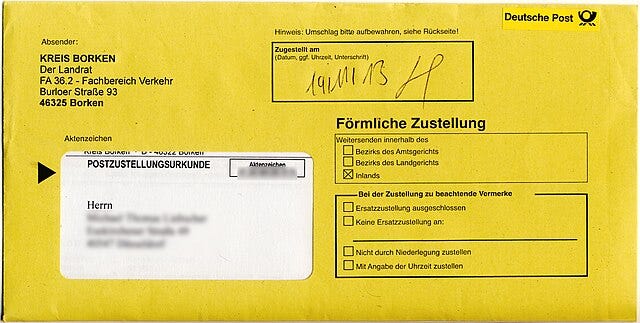
I held the paper in my hand. It was thick, greyish, and covered in timestamps. This wasn’t a request; it was a verdict.
I had been waiting for this for six weeks. In fact, because the offense happened in mid-November and my mailbox stayed empty through Christmas, I had lulled myself into a false sense of security. Maybe the officer forgot? Maybe the paperwork got lost?
I opened the letter, expecting a simple bill. Instead, I got a three-page dissertation on my rights, my failures, and the precise nature of my debt to society. Here are the 5 Cultural Lessons hidden in the fine print.
1. The “German Clock”: Why Silence is Not Amnesty
The Insight: The False Sense of Security & The “Zwischen den Jahren” Phenomenon
The first thing I noticed was the date. The offense happened on Nov 14th. The letter was dated Dec 29th.
This 6-week gap is a classic expat trap. In many countries, if you don’t hear back in a month, you assume you got away with it. In Germany, the statute of limitations is 3 months. As long as they print the letter before that date, they are safe.
Why the delay?
Police vs. City Handover: The letter notes “Beweismittel: Anzeige Polizei” (Evidence: Police Report). Because the State Police stopped me, but the City of Leipzig fines me, the paperwork had to physically travel between bureaucracies.
“Zwischen den Jahren”: The letter is dated Dec 29th—right in the dead zone between Christmas and New Year’s. While I was eating leftover gingerbread, a clerk was clearing their desk to ensure my case didn’t drag into the next fiscal year. The system doesn’t forget; it just queues.
The Lesson: A long silence isn’t forgiveness; it’s just the bureaucracy taking a deep breath.
If you are enjoying this article, then you will also like...
2. Equality of Mobility: The Bike is Not a Toy
The Insight: The Bike as a Legal Entity
The accusation in the letter was chillingly specific. It didn’t just say I ran a red light. It read:
“Sie missachteten als Radfahrer das Rotlicht… Die Rotphase dauerte bereits länger als 1 Sekunde an.”
(“As a cyclist, you ignored the red light… The red phase had already lasted longer than 1 second.”)
That “1 second” is crucial. It distinguishes a “momentary lapse” from “gross negligence.” Because I crossed after that second, my fine jumped from €60 to €100.
But the real shock came at the bottom of the page:
“Nach Rechtskraft … wird die Entscheidung mit 1 Punkt(en) bewertet und im Fahreignungsregister (FAER) in Flensburg eingetragen.”
(“…graded with 1 point and entered in the Driving Aptitude Register in Flensburg.”)
The Lesson: The German state views “traffic fitness” as holistic. Even though I was on a bicycle, I earned a point on my driver’s license record. In Germany, you aren’t a “harmless cyclist”; you are a pilot of a vehicle (Fahrzeug), and you are held to the same standard of reliability as a truck driver.
3. The “Polluter Pays” Principle: You Buy the Paperwork
The Insight: The Verursacherprinzip
I looked at the total amount due. It wasn’t €100. It was €128.50.
The breakdown in the table was revealing:
Geldbuße (Fine): €100.00
Gebühr (Fee): €25.00
Auslagen (Expenses): €3.50
The Lesson: This is the Verursacherprinzip (Polluter Pays Principle). The German taxpayer does not subsidize your bad behavior. The “Fine” is the punishment. The “Fee” pays for the clerk’s salary to process it. The “Expenses”? That literally covers the cost of the paper and the yellow envelope I was holding. You broke the rules, so you have to fund the administrative machine that corrects you.
4. The Digital Struggle: Rechtsstaat vs. User Experience
The Insight: Form Over Function & Procedural Fairness
As a modern expat, my instinct was to fire off a quick email to explain. I flipped to page 2, and the letter immediately shut that down:
“Mit einfacher E-Mail an die umseitig genannte E-Mail-Adresse kann nicht formgerecht Einspruch eingelegt werden.”
(“A formal objection cannot be filed via simple email.”)
It goes on to say that if I want to object electronically, I need a “qualified electronic signature.”
The Lesson: Germany prioritizes Legal Certainty (Rechtssicherheit) over your convenience. A standard email is considered insecure and legally ambiguous. However, this rigidity comes with a silver lining: Procedural Fairness. The letter spends pages explaining my right to be heard (Rechtliches Gehör). The state doesn’t just punish; it invites me to a legal dialogue—but only if I follow its strict, non-digital protocols.
Still fighting with German Bureaucracy? Check out my take on the mindshift need.
5. The Ultimate Threat: Erzwingungshaft
The Insight: The Absolute Authority of the State
Finally, buried in the fine print, I saw a word that looks like it belongs in a dungeon:
“Dabei kann das Amtsgericht gegen Sie Erzwingungshaft anordnen…”
(“The district court can order coercive detention against you…”)
The Lesson: Don’t panic—this isn’t debtor’s prison. You don’t go to jail for being poor (the letter explicitly invites you to prove inability to pay to get an installment plan). You go to jail for ignoring the state.
The term Erzwingungshaft reveals the German state’s zero-tolerance policy for “ghosting.” They will negotiate with you, they will listen to you, but if you simply ignore the yellow envelope, they will detain you to enforce cooperation.
The Final Takeaway
Holding this letter, I realized it wasn’t just a fine. It was a contract.
I had disrupted the Ordnung. The state responded with a slow, expensive, but incredibly transparent process to restore it. They treated me not as a “clueless foreigner,” but as a Mündiger Bürger—a responsible citizen capable of understanding my duties.
So, I logged into my banking app, paid the €128.50, and closed the loop.
Next time you see that Yellow Envelope, take a deep breath. It’s scary, and it’s strict, but it’s fair. Just make sure you open it immediately.
Have you ever wrestled with German bureaucracy? How did you handle the “legalese”? Let me know in the comments! 👇